BMW N20 Timing Chain Failure
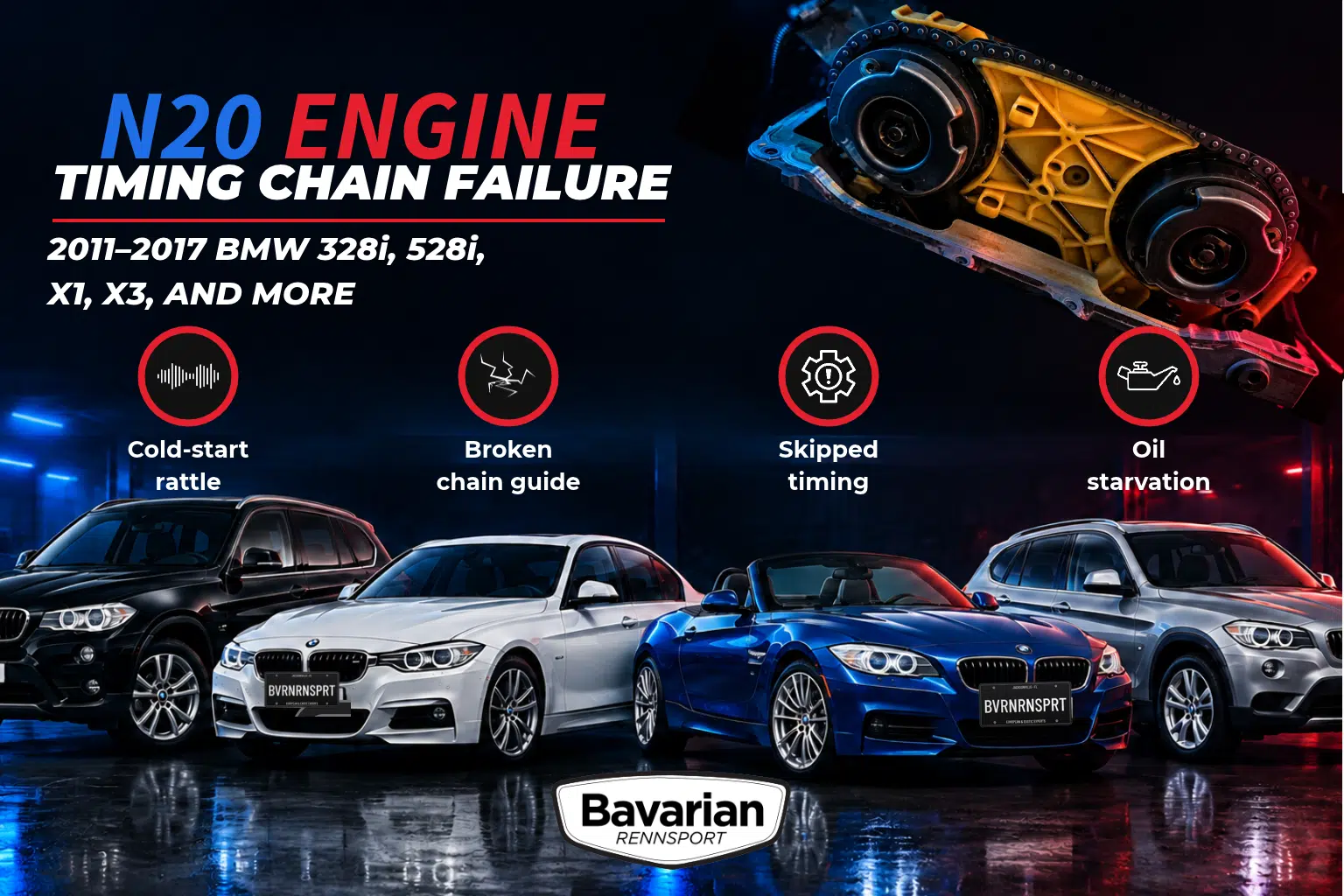
The sound you can't drive past
Warning Signs Your BMW N20 Timing Chain May Be Failing
The most important warning sign of your timing chain needing immediate replacement is a metallic rattle you hear for the first few seconds of a cold start. That rattling sound you're hearing on your 2011-2017 BMW isn't the engine warming up. A proactive check is the cheapest and most efficient way to catch these issues before too late.

Checking it every 6,000–7,000 miles can help you avoid a costly repair if you wait too long. This isn't a sound you can ignore, and ignoring it could result in engine failure.
Engine failure gives you three options:
- Rebuild your existing engine
- Swap for a remanufactured engine
- Install a crate engine.
We cannot stress how important it is to get your N20 engine checked so you can avoid unnecessary costs on an otherwise highly reliable engine.
What is a timing chain?
The timing chain sits at the front of the engine and connects the crankshaft to the camshafts, spinning them at exactly half the crankshaft's speed so every rotation lines up the same way, cycle after cycle. The one chain has to keep the camshafts and crankshaft in sync down to the millisecond. The N20 engine relies on the timing chain to ensure precise movement of the valves and pistons, allowing for the cycle to run seamlessly. If a valve and piston end up in the same place at the wrong moment, the valve bends. A bending valve stops the cylinder from being able to seal properly, damaging the pistons and stopping the engine from running.

To simplify, the timing chain resembles the functions of a classic bicycle chain. Just like a bike chain, it relies on guides and a tensioner to stay aligned and taut. On the N20, the plastic guides and the tensioner are what wear out first, long before the chain itself does.
What causes the timing chain to fail?
On an N20 engine, a plastic composition guides the chain along its track. In the long run, the repeated heat cycles, especially on a turbocharged engine, result in the plastic drying out and losing its flexibility. This is more damaging the longer you go without an oil change, as fresh oil keeps the plastic guides lubricated so they can flex. The heat leads to the plastic inevitably snapping after one too many micro cracks. The chain now has extra slack that throws off the engine's timing.
With enough slack, the chain can skip a tooth on the crankshaft or camshaft sprocket, throwing the valves and pistons out of sync. Not only this, but the debris from these micro cracks falls into the oil pan. The oil pan has a mesh screen that filters out debris, and these plastic pieces clog it, stopping the needed oil from reaching the pump.
Does my car have the N20 engine?
BMW put the N20 in several BMW models between 2011 and 2016, including the 328i (F30), 528i (F10), X1, X3, and Z4. If you drive one of these from that window, this issue applies to you directly, no matter how well the car runs otherwise.
Included in a proper repair is more than replacing the chain: the guides, the tensioner, and usually the VANOS solenoids and water pump while the front of the engine is already apart. Skipping the guides and tensioner and only replacing the chain means bringing your BMW back in for the same job another 20,000–30,000 miles later.
The bottom line on the N20 timing chain failure
Get the chain checked before it rattles into a rebuild. Whether you're due for service, buying a used N20-equipped BMW, or selling one, book a pre-purchase or post-purchase inspection with us. A full inspection catches this early, while it's still a routine fix instead of a five-figure decision. If you're hearing that rattling sound, you're no longer looking at a chain job; you're looking at an engine-out repair. Don't worry if it's already gotten that far; Bavarian Rennsport rebuilds and repairs N20 engines, so whether it's a straightforward chain job or a full engine-out rebuild, we'll get your BMW back on the road.
Book Appointment
Please be advised that in the event of any unexpected wait time other clients' vehicles may take longer than expected to diagnose and treat so unfortunate delays do occur. We will get to your vehicle as soon as possible.





 Email Us
 (904) 270-9390