European Car Oil and Coolant Leaks: What That Drip in Your Jacksonville Driveway Means
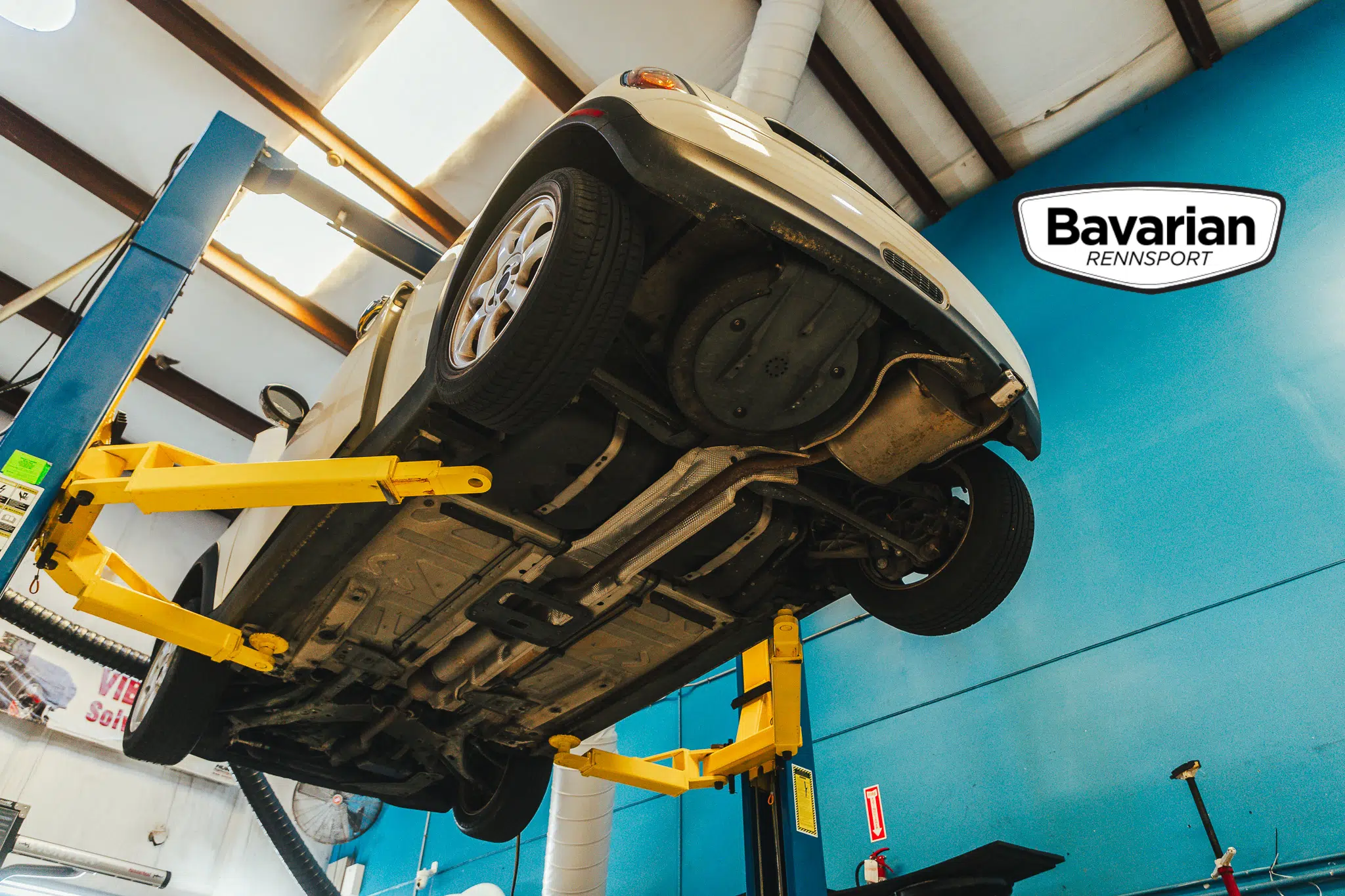
You back out of the garage and there it is: a few drops on the driveway where the car sat overnight. If you drive a BMW, Audi, Porsche, Mercedes-Benz, or MINI, that drip is one of the most common reasons owners call us. At Bavarian Rennsport, an independent European auto repair shop in Jacksonville, Florida, we trace oil and coolant leaks every week, on everything from daily-driven MINIs to Ferraris and Lamborghinis that only come out on weekends. Our customers come from Southeast Georgia down to Palm Coast, and most of them start with the same question: how worried should I be?
Usually not very, as long as you deal with it. Here's how to read the drip, which parts usually cause it, and when to stop driving.
Why European cars are known for leaks (and why that's manageable)
European engines are packed tightly and run hot. Turbochargers and compact engine bays put gaskets, seals, and plastic cooling parts through thousands of heat cycles. Over time, rubber hardens, gaskets shrink, and plastic turns brittle. That's normal wear, not a sign the car was built badly.
Florida heat and humidity add to it, keeping engine bays hotter for more of the year. That's why we see the same handful of leak points again and again.
The good news: caught early, a leak is usually manageable. A seeping gasket is a defined repair. A gasket that has leaked onto belts and hoses for a year is a bigger one.
Reading the drip: oil, coolant, transmission or power-steering fluid, and A/C water
Slide a piece of white cardboard under the car overnight. Then check the color, feel, and smell of the drops, and where they landed.
Engine oil runs from amber when it's fresh to dark brown or black when it's older. It feels slick and doesn't evaporate. If it's reaching hot exhaust parts, you'll often smell burning oil after a drive.
Coolant is thinner than oil and has a sweet smell. It's usually green, blue, pink, or purple, and it can leave a crusty residue as it dries. It's toxic to pets, so clean up any puddle.
Transmission or power-steering fluid is often red or amber, and some power-steering fluids are green. Transmission fluid tends to show up mid-car, and power-steering fluid, on cars with a hydraulic system, near the front.
A/C water is clear, has no smell, and feels like water, because it is. A small puddle near the front of the car after a drive with the A/C on is normal, especially in a Jacksonville summer.
Treat all of this as a starting point, not a diagnosis. Oil and coolant can run along the engine or a heat shield and drop off well away from the leak, and old fluids change color. The drip tells you something is leaking. It doesn't reliably tell you what, or where.
The oil leak parts we see most
Two gaskets account for a large share of the oil leaks we find: the oil filter housing gasket and the valve cover gasket. Both are rubber, and both live next to a lot of heat.
Oil filter housing gasket
On BMW six-cylinder engines and the MINI Cooper, the oil filter housing gasket is a well-known leak point. The trouble is where it sits: oil from a failing housing gasket can reach the drive belt, which softens and can fray or slip. Our BMW service in Jacksonville and MINI Cooper service include a look at this area on every visit.
Some Mercedes-Benz V6 engines have a similar weak spot at the oil filter housing and oil cooler seals. The leak often shows up far from where it starts (see the example below), so our Mercedes-Benz oil leak diagnosis always starts by finding the highest wet point.
Valve cover gasket
The valve cover gasket seals the top of the engine. When it hardens, oil seeps out and can run onto the exhaust manifold or turbo, the usual source of a burning-oil smell. We see it on BMW and MINI engines, and on Audi and VW turbo four-cylinders, where it's often replaced together with PCV (crankcase ventilation) parts. A tired PCV system pushes oil past seals, so fixing one without checking the other can mean a repeat visit. Our Audi repair in Jacksonville team checks both.
Porsche engines have their own versions: cam and valve cover seals that harden with age and heat. Our Porsche service covers the models we see most.

The coolant leak parts we see most
Most coolant leaks come from plastic and rubber parts under constant heat and pressure. Three parts cover most of what we find.

Expansion tank
The expansion tank holds extra coolant and absorbs pressure as the system heats up. On BMW, MINI, Mercedes-Benz, and Audi/VW models, it's plastic, and plastic tanks crack with age and heat cycles. Early signs include a slowly dropping coolant level, dried residue on the tank, or a sweet smell after a drive.
Water pump
Many BMW models use an electric water pump. When one fails, it can leak or stop pumping with little warning. On Audi and VW 2.0T engines, the water pump and thermostat housing are a plastic module, and seepage from that module is common as it ages. On Porsche flat-six engines, the water pump is a known wear item. A pump that has started to weep is worth replacing before it quits.
Thermostat
Thermostat housings on BMW, MINI, and Mercedes-Benz engines can crack and leak, and the thermostat itself can stick. Stuck closed, the engine overheats. On many Audi/VW 2.0T engines, the thermostat is built into the pump module, so it's usually handled together with the pump.
Can I keep driving with a coolant leak?
Sometimes. A small seep with a steady temperature reading can usually make it to an appointment. Check the coolant level when the engine is cold, and top off with the coolant specified for your car.
A low-coolant warning, a rising temperature gauge, steam from under the hood, or a puddle under the car means stop driving. Overheating can warp a cylinder head or damage a head gasket, and either one costs far more than the leak that caused it. Pull over somewhere safe, shut the engine off, and arrange a tow.
Never open a hot cooling system. It's under pressure and can burn you. If in doubt, call us at (904) 270-9390.
A common scenario we see: the leak that isn't where it drips
Here's a typical case we see (an illustrative example, not a specific customer). A Mercedes-Benz with a V6 comes in because the owner has noticed a burning-oil smell after driving and a few dark drops on the driveway toward the back of the engine.
The drip alone doesn't tell the whole story. On many of these V6 engines, the oil filter housing and oil cooler sit in the valley on top of the engine, so oil from a tired seal can run down the back of the block and drip off near the transmission, well away from where it started. Our technicians clean the area, inspect from above and below, and trace the wet trail back to its highest point before recommending anything, so you don't pay to replace a gasket that wasn't leaking.
In this scenario, the fix is replacing the oil filter housing and oil cooler seals, then confirming the area stays dry. Caught early, it's a seal job. Left alone, oil can soak engine mounts, rubber hoses, and wiring, and drip onto hot exhaust parts, turning a manageable repair into a bigger one.
Labor is billed at our published European rate, starting at $175/hour, and during diagnostics we document what we find with photos, videos, and fault code scans, so you can see what needs attention now and what can wait.
What does a leak repair cost?
It depends on which part is leaking, how much has to come apart to reach it, and the model. That's why we don't quote a leak repair over the phone.
What we can tell you up front is the labor rate. Our published rates are $175/hour for European brands and $200/hour for exotics. During diagnostics, we document what we find with photos, videos, and fault code scans, so you can see what needs attention now and what can wait before you approve any work.
Exotics and low-mileage cars: why seals still age when a Ferrari or Lamborghini sits
Low miles don't mean young seals. Rubber and plastic age with time and heat whether the car is driven or not. A Ferrari or Lamborghini under a cover in a Jacksonville garage still lives through a Florida summer, and its seals harden on the calendar, not the odometer. Dried seals can also start to weep once the car is driven again.

For weekend cars and covered exotics, including the occasional McLaren or Aston Martin, a leak check at each service visit is a good habit. Exotic labor is billed at our published exotic rate of $200/hour.
What happens if you wait: belts, hoses, mounts, and overheating risk
A slow leak is rarely just a stain. Oil on a drive belt softens it until it slips or frays. Oil that soaks mounts and rubber hoses breaks them down early, and oil on hot exhaust parts smokes and smells.
Coolant leaks carry a different risk: overheating. A tank or pump that seeps this month can let go next month. If you're already planning seasonal service, our fall maintenance checklist covers the cooling system, too.
Catching a leak early is usually simpler, whether you drive across town in Jacksonville, Florida or come in from Southeast Georgia or Palm Coast.
How we find the leak: free inspection and diagnostics
Every quick service and repair job at Bavarian Rennsport includes a free inspection, and that includes a look through the engine bay for oil and coolant leaks. When a leak needs tracing, our technicians clean the area, inspect from above and below, and follow the wet trail to its highest point before recommending a repair.

During diagnostics, we document findings with photos, videos, and fault code scans, and we separate what needs attention now from what can wait. Our repairs carry a warranty of 2 years / 24,000 miles (exclusions apply).
Frequently asked questions
What does a drip under my European car in Jacksonville mean?
Usually that a gasket, seal, hose, or plastic cooling part has started to leak. If the drip is clear, odorless water near the front of the car after the A/C has been running, it's most likely normal condensation. Color, feel, smell, and location are useful clues, but oil and coolant can travel along the engine before they drip, so the spot on your driveway isn't always where the leak starts. An inspection at Bavarian Rennsport in Jacksonville, Florida traces it back to the source.
Can I keep driving with a coolant leak?
A small seep with a steady temperature reading can usually make it to an appointment if you check the level when the engine is cold and top off with the specified coolant. A low-coolant warning, a rising temperature gauge, steam, or a puddle means stop driving, because overheating can warp a cylinder head or damage a head gasket. Never open a hot cooling system. If in doubt, call (904) 270-9390.
How much does European car oil leak repair cost in Jacksonville?
It depends on the part, how much has to come apart to reach it, and the model. Bavarian Rennsport's published labor rates are $175/hour for European brands and $200/hour for exotics. During diagnostics, we document what we find with photos, videos, and fault code scans, so you can see what needs attention now and what can wait.
Do exotics that sit still need leak checks?
Yes. Seals and hoses age with time and heat, not just miles, so a Ferrari or Lamborghini that sits in a Florida garage can still start to leak. A leak check at each service visit catches it early.
Do I need an appointment?
Yes. We're appointment-only, with 24/7 drop-off. We offer complimentary one-way ride share on major services and repairs. Book at BavarianRennsport.com/book-appointment or call (904) 270-9390.
Does Bavarian Rennsport serve customers outside Jacksonville, Florida?
Yes. We're in Jacksonville, Florida, and our customers come from the surrounding area, from Southeast Georgia down to Palm Coast, including the Beaches, Ponte Vedra, Nocatee, St. Augustine, Orange Park, Amelia Island, Fernandina, and Brunswick.
Book a leak inspection in Jacksonville
Found a drip, or smelled oil or coolant after a drive? Bring the car in before the leak grows. Bavarian Rennsport is at 2027 Mayport Road, Jacksonville, FL 32233. We're open Monday–Friday, 9:00 AM–7:00 PM, and closed Saturday and Sunday.
We're appointment-only, with 24/7 drop-off. We offer complimentary one-way ride share on major services and repairs.
We serve Jacksonville, Florida and the surrounding area, and our customers come from Southeast Georgia down to Palm Coast, including the Beaches, Southside, Westside and Northside of Jacksonville, plus Jacksonville Beach, Atlantic Beach, Neptune Beach, Ponte Vedra, Nocatee, St. Augustine, Orange Park, Amelia Island, Fernandina, and Brunswick.
Book a leak inspection or call or text (904) 270-9390.
Book Appointment
Please be advised that in the event of any unexpected wait time other clients' vehicles may take longer than expected to diagnose and treat so unfortunate delays do occur. We will get to your vehicle as soon as possible.





 Email Us
 (904) 270-9390